
My AI memory should be allowed to say "I don't know"
I wanted to export my ChatGPT data. My full data export was going to take at least five more days, and I was impatient, so I did something slightly silly: I asked ChatGPT to dump everything it remembered about me, in one block, as a list.
It worked. A little too well. There were my projects, my tools and my habits, and also my health, my money and my family, in one tidy paragraph, in a product I had never once been shown that paragraph in.
That was the moment this project started. Not "memory is cool", but: why can't I read this, correct it, or take it with me, and why would I trust something that I can't check?
So I built MemBridge for the FalkorDB hackathon. It keeps an assistant's memory of you on your own machine, as a graph, with the receipts attached.
- Code: https://github.com/chinchoooo/membridge
- Try it without installing anything (synthetic data, read-only): https://membridge-sandbox.onrender.com
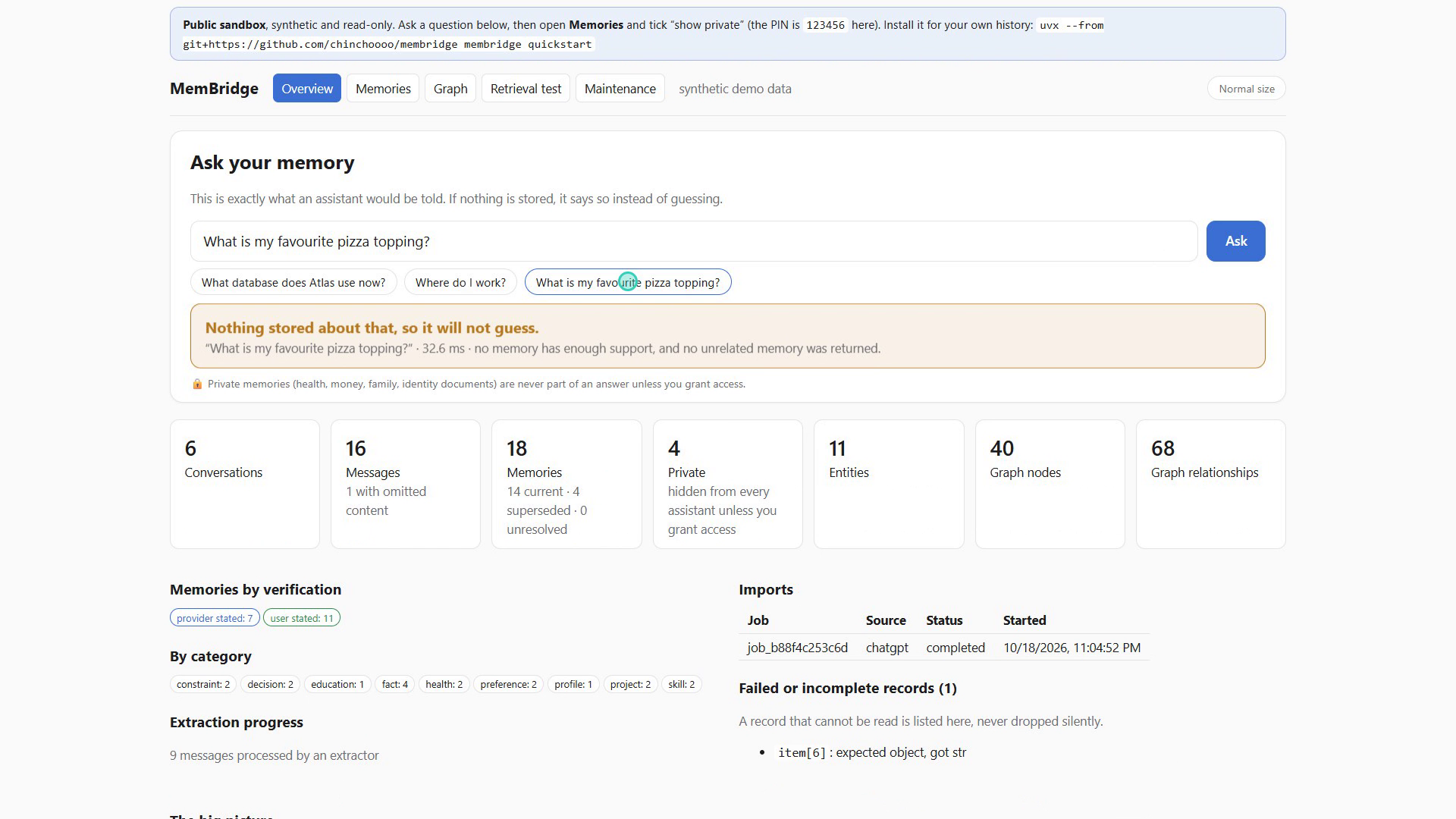
The feature I'm proudest of is a "no"#
Most memory demos are about what the assistant knows. I got more interested in what it does when it doesn't.
Ask a typical system "what's my favourite pizza topping?" and a helpful one will reach for the nearest thing it has and give you something that sounds right. MemBridge has an evidence gate: if no stored memory supports the question well enough, the answer is "Nothing stored about that, so it will not guess." No unrelated memory gets attached to soften the blow.
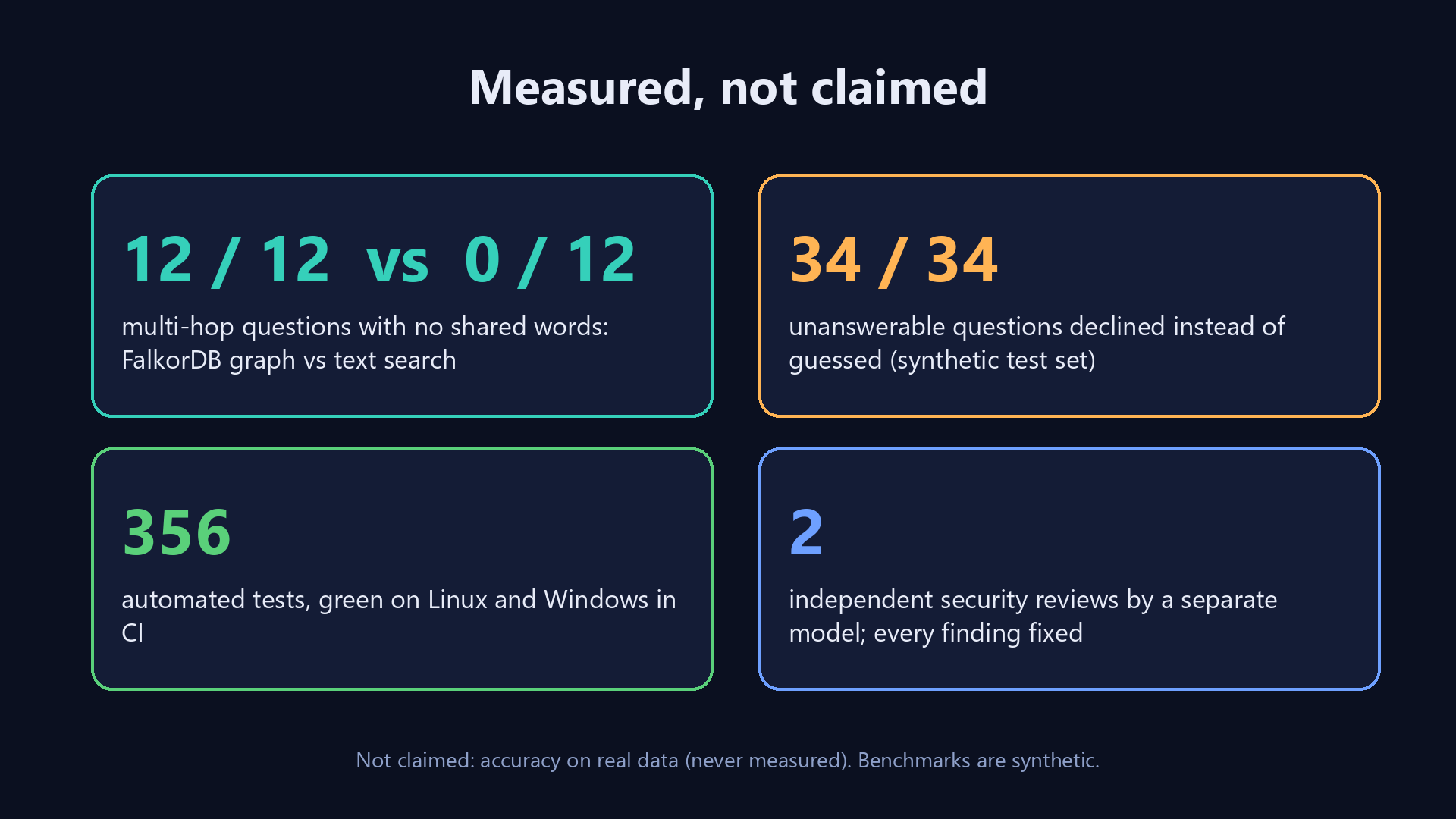
In my test set, 34 of 34 unanswerable questions were declined, and 32 of the 33 answerable ones were answered. Those are numbers from a benchmark I wrote myself, so please read them as "the mechanism works", not "it is 97% accurate on your life". I don't know that yet, and I would rather say so than guess, which is a little on the nose for this project.
Three rules that shaped everything#
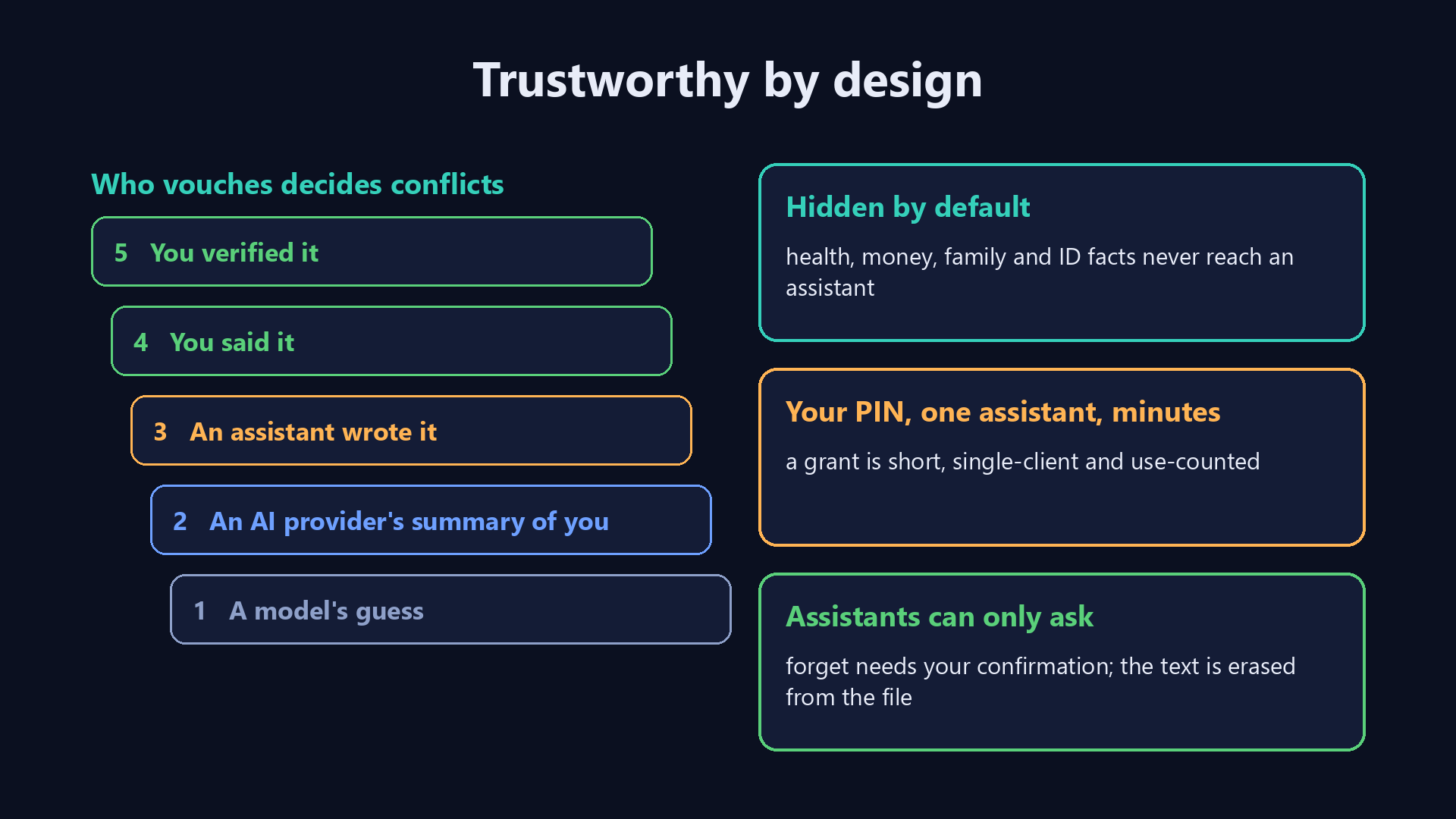
1. What you said beats what a provider summarised. Every memory carries a trust level: you verified it, you said it, a client asserted it, a provider summarised it, a model inferred it. If ChatGPT's summary says I work at one company and I told it, in my own words, that I work at another, mine stays current and the summary is kept as history, not deleted.
2. Private means private, by default. Health, money, family and identity-document facts are hidden from every assistant. To let one assistant read them, I set a PIN, then grant that one assistant a few minutes and a couple of reads. An assistant can't grant itself access, and it can't delete anything: it can only ask to forget something, and I confirm. When I confirm, the text is actually scrubbed from the database file, not just hidden. I checked the raw bytes.
3. Everything has a source. Every fact links back to the exact messages it came from. "Why did you say that?" should always have an answer.
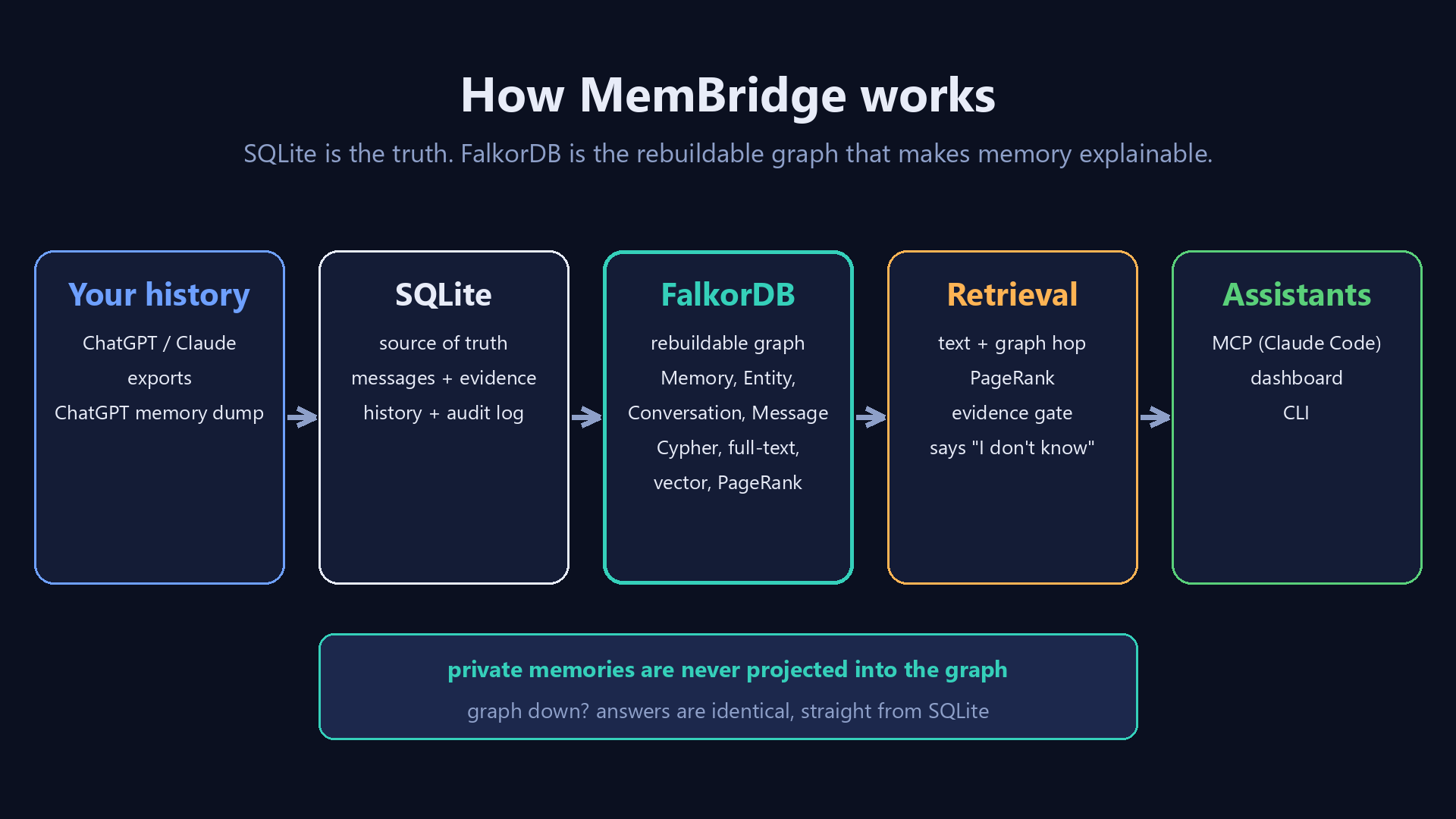
Where FalkorDB comes in#
Under the hood, SQLite is the source of truth, and FalkorDB holds a rebuildable graph projection of it. I made that choice on purpose: if the graph is down, answers are the same; if it gets weird, I drop it and rebuild it. A parity test checks that the graph path and the SQLite fallback agree.
The graph has Memory, Entity, Conversation, Message, Source, User and Community nodes. Private memories never go in it at all.
Here is what FalkorDB actually does for me:
- Cypher paths I can show a person. When an answer comes through the graph, it comes with the path: message, conversation, project, decision. That is the "receipts" part.
- Full-text indexes on memory statements and entity names and aliases, and range indexes for the common filters.
- An optional HNSW vector index for fuzzy semantic lookups.
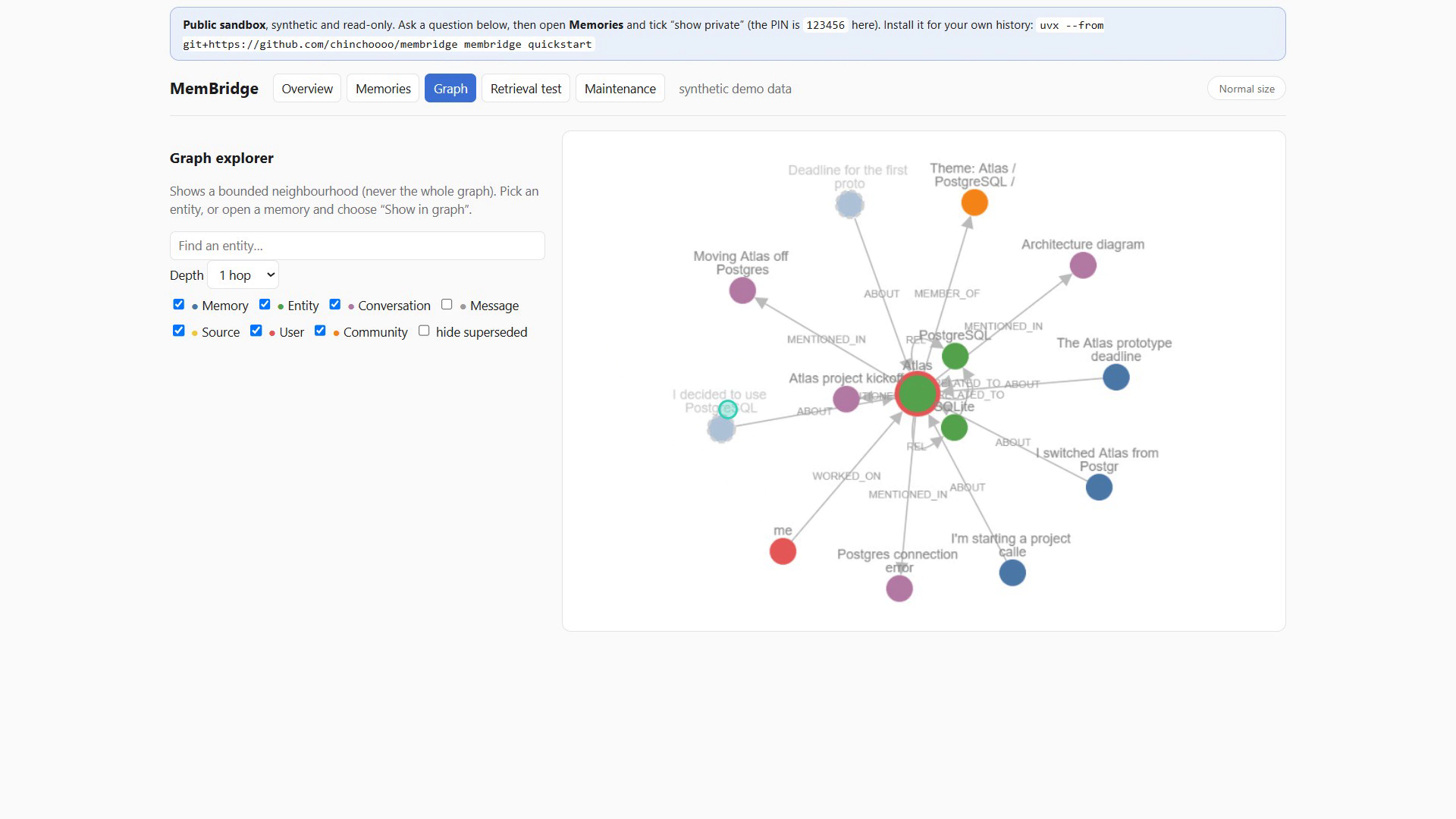
algo.pageRankandalgo.WCCfor a "big picture" view: what matters most in your life, and which clusters exist.- Bounded neighbourhood queries behind the dashboard's graph explorer. It never tries to draw the whole graph, because nobody wants to see that.
- Batched
UNWIND/MERGEso new memories update the graph incrementally.
"But does the graph actually help?" My own question, tested#
I was suspicious of my own project here. It is very easy to bolt a graph database onto something and say it helps. So I wrote a test where a graph should matter and plain text search should fail.
The 48-question benchmark includes 12 lexical-gap questions: questions where no stored fact shares a single word with the question. For example, "What did I change after the ZX0 timeout?" The answer is a decision that never mentions ZX0. But the message that does is linked to a conversation, which is linked to a project, which is linked to the decision. Text search has nothing to grab. A graph can walk there.
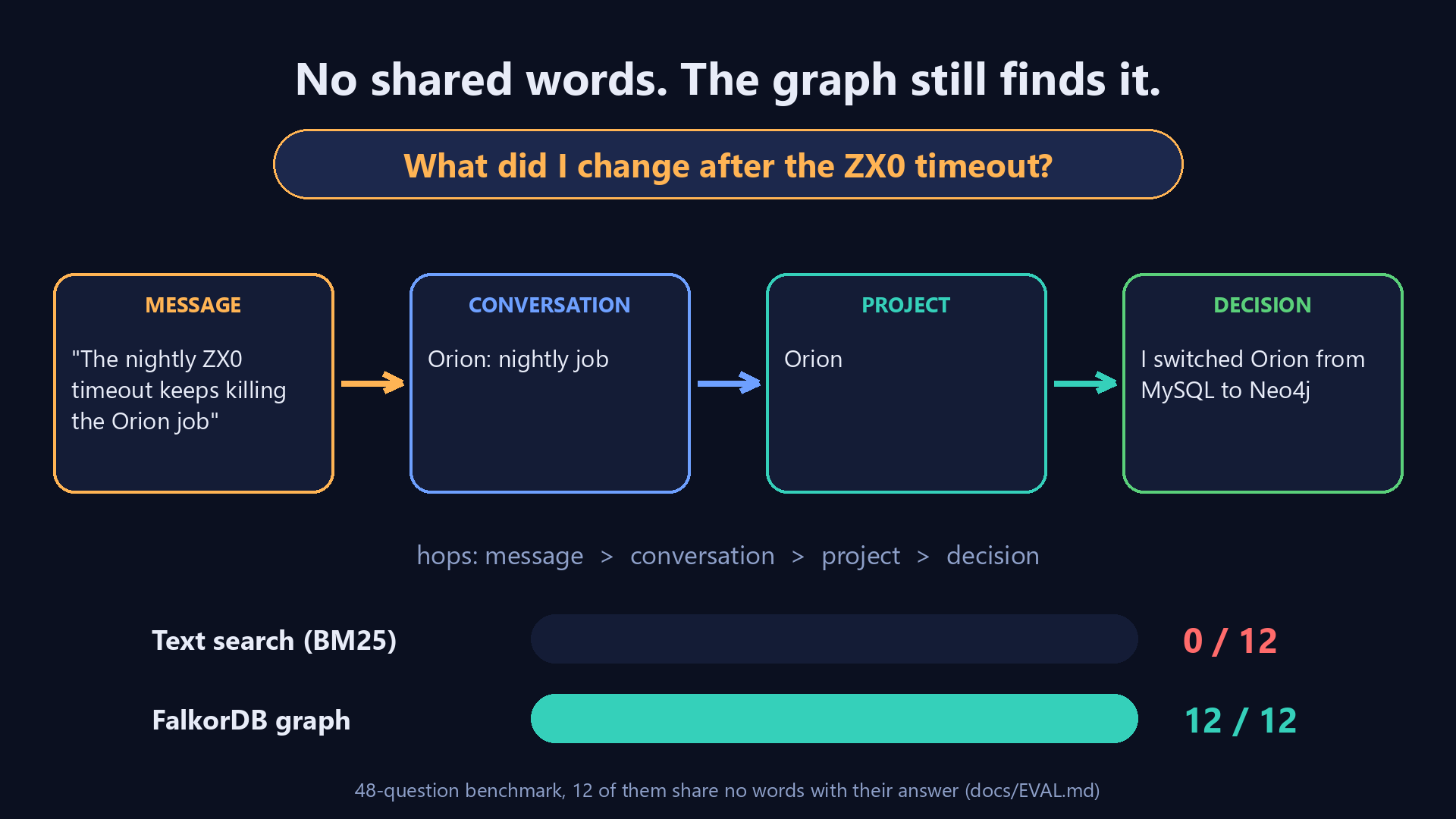
| Lexical-gap questions answered | |
|---|---|
| Text search only (BM25) | 0 / 12 |
| Full pipeline with the FalkorDB graph | 12 / 12 |
That 0 is the number I like most. It is not a case where the graph was slightly better. Without it, the system couldn't answer at all.
Things that did not go as planned#
I would rather tell you these than pretend it was smooth.
- The graph is not faster. In my ablation, retrieval through the graph took about 15.6 ms against 8.3 ms for SQLite alone. The reason to use it is what it can do, not how quickly. On a real archive, a cold query still comes back in about 14 ms, which is nothing for an assistant, but I won't sell it as a speed win.
- I had to do personalised PageRank myself. FalkorDB's
algo.pageRankis global, and retrieval wants PageRank seeded from the question. So I load a bounded neighbourhood with a breadth-first Cypher query and run personalised PageRank in Python. It works nicely, but it was not a built-in. - A sandbox could see my real graph. I had two independent adversarial reviews of the code, and one of the things they found was that, on a developer machine, the public sandbox mode could read the owner's real FalkorDB graph. It now has its own dedicated graph. Every finding got fixed before I made the repo public.
- My demo leaked its own punchline. The made-up demo person had "private" facts that were not actually marked private on import, until I noticed and made the import upgrade anything the sensitivity lexicon flags. It is exactly the kind of bug a demo hides from you, until you look at it the way a stranger would.
Try it in about a minute#
uvx --from git+https://github.com/chinchoooo/membridge membridge quickstart
No cloning and no Docker. It loads a made-up person and opens a dashboard with an Ask your memory box. Ask where the person works. Then ask for their favourite pizza topping, and watch it say no.
To use your own history, membridge dump-prompt gives you the prompt I used on ChatGPT. Paste it in, copy the reply back, and it imports as ChatGPT's belief, never as something you said.
Where it stands#
MemBridge has 357 automated tests, green on Linux and Windows, and everything above is in the repo, including the benchmark so you can break my numbers yourself. It is a hackathon project and not a finished product, and I haven't measured accuracy on anyone's real data, including mine.
I think FalkorDB is the right shape of tool for this problem: memory is a web of people, projects, decisions and the moments they came from, and asking "how did we get here?" is a path question. If you try it and it says something wrong, or confidently refuses something it should know, I would honestly love to hear about it.
Thanks for reading.