
Reading ARTIST
- venue
- arXiv 2026
- status
- reviewed
- tl;dr
- ARTIST uses an adaptive controller to select useful time-series segments before a reasoner answers questions about them.
This document is a technical review of ARTIST: Adaptive Time Series Reasoning via Segment Selection (arXiv 2602.18645v3), written in my own words, followed by my own interpretation and a proposed extension. Facts about the paper are drawn directly from it and cited by page or section. The review separates the paper's reported results from my own interpretation and proposed extension.
The problem ARTIST solves#
ARTIST targets natural language question answering over time series where the question needs genuine temporal reasoning: locating and interpreting a specific pattern in the signal, rather than giving a generic description of it. Feeding an LLM a very long raw sequence end to end makes this harder. In a signal like a 4000 step whale call recording, the relevant local pattern can be a small fraction of the sequence, and reasoning over the whole thing at once can make the relevant local structure harder to isolate.
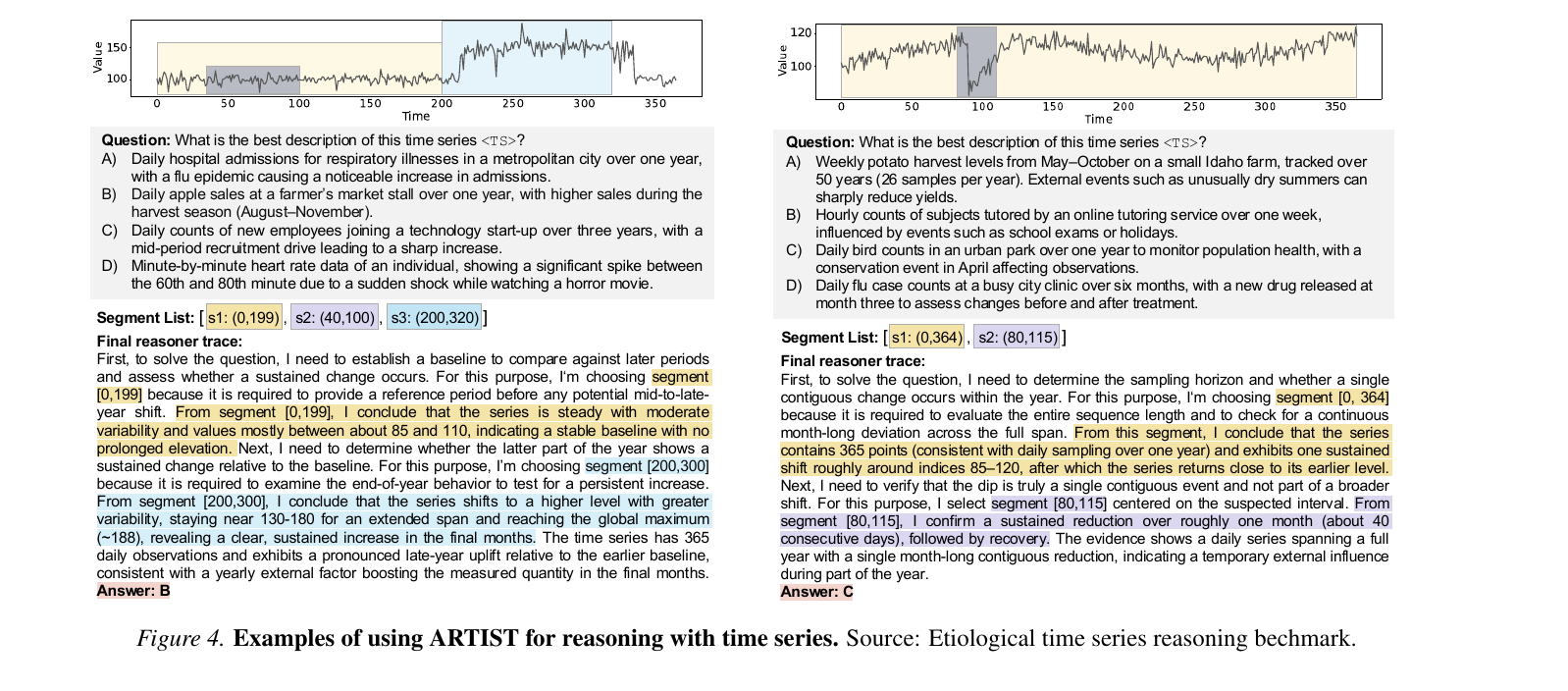
ARTIST's answer is to treat the time series as a source that can be selectively queried, rather than something the model must consume in full before answering. A controller repeatedly chooses which part of the series to look at, and a reasoner analyzes only what was retrieved.
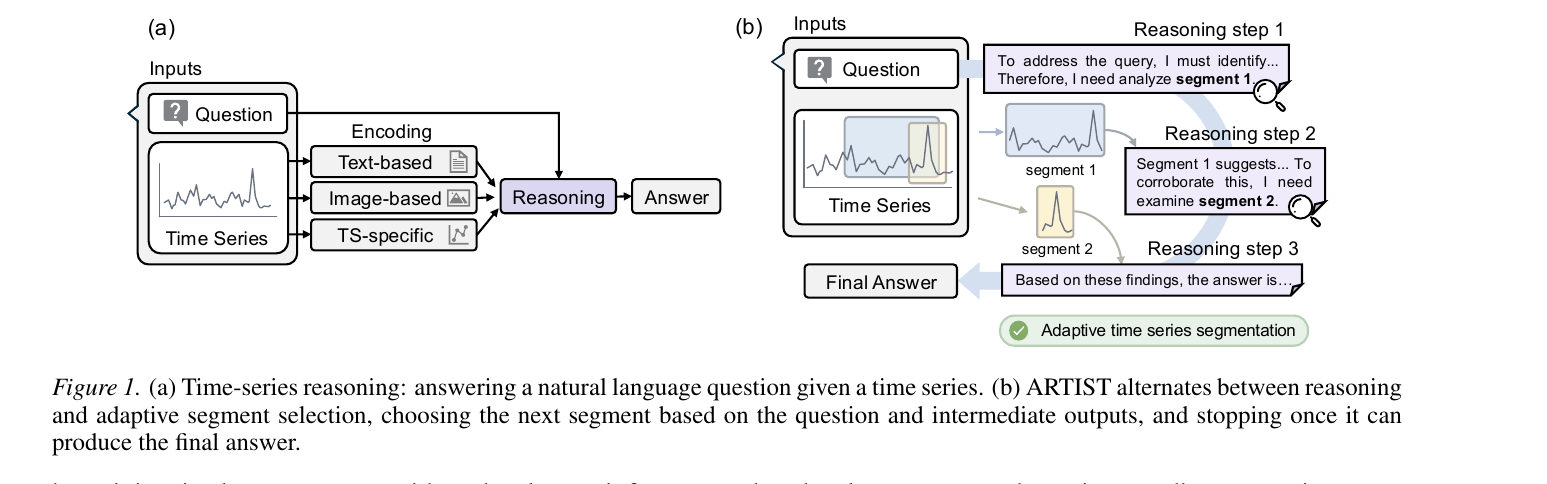
How ARTIST works#
Formalization. ARTIST factors the answer distribution through a latent reasoning trace . Here is the question, the full time series, the answer, and the controller/reasoner interaction trace.
The loop. At round , the controller observes a state capturing the question, the full series, everything selected so far, and the reasoner's last output:
It produces whether to continue, a short rationale, and the next segment to retrieve:
The reasoner then receives that segment and produces its own rationale and intermediate answer:
This repeats until the controller decides it has enough evidence, building a trajectory of controller/reasoner exchanges (Eq. 6).
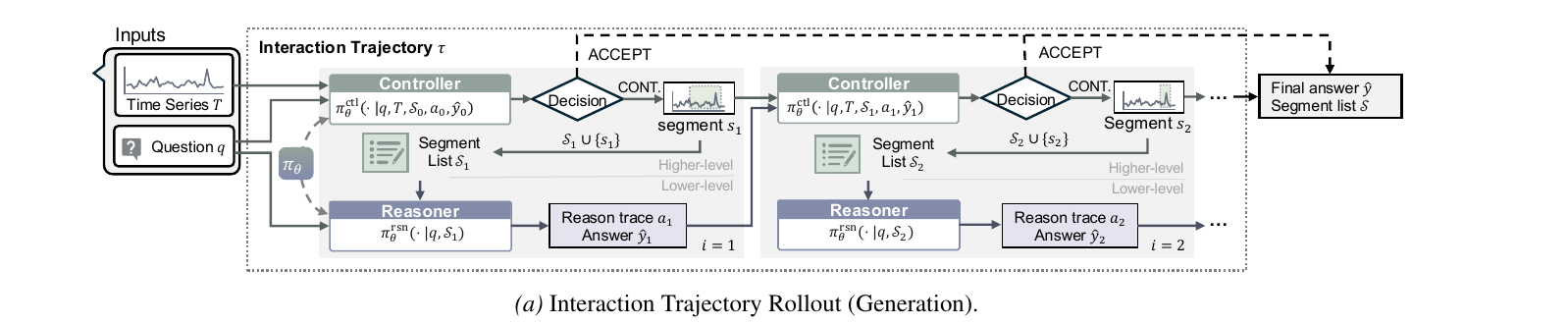

Important detail. Per the paper's own Appendix F controller prompt, the controller has access to the full series at every round, not just the segments selected so far. It decides what to retrieve next by looking at everything, not by working blind outside its own selections.
Training. There are two stages: supervised fine tuning (LoRA) to teach the output format, then full parameter RL (a GRPO style collaborative self play) to optimize both policies jointly. The reward design:
Correctness reward , from matching the final answer (Eq. 7).
Reliability reward , the mean correctness over resampled rollouts, which rewards segment choices that lead to a consistently correct answer rather than a lucky one (Eq. 8).
Controller format score (Eq. 9) combines with and into the controller reward:
The reasoner reward (Eq. 11) is scored separately and is the only one regularized with a KL term () against the reference policy.
Variance guided sampling concentrates rollouts on questions where reward variance across the group is high:
This feeds a sampled group reasoner reward (Eq. 13).
- The joint objective combines both policies' objectives:
Experimental setup#
Six benchmarks span very different sequence lengths and task types (paper, page 8):

TSQA: shortest sequences ( steps). ARTIST's single biggest gain is here (+12.5 pts).
RCW (whale call): longest, fixed length ().
ECG QA: fixed length ().
Sleep QA: fixed length (), 5 class.
TRQA: characterization only, .
ETI: causal and etiological questions, .
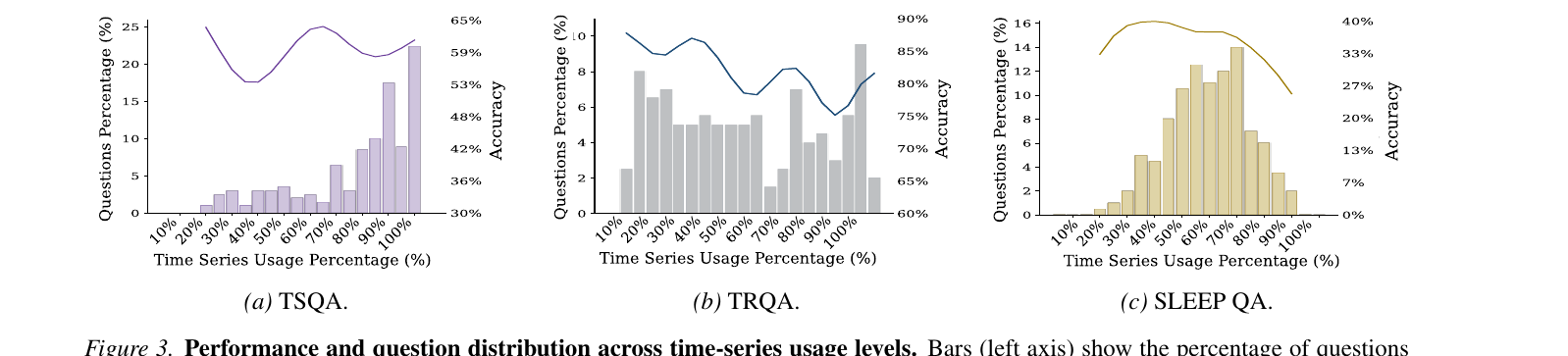
Main results#
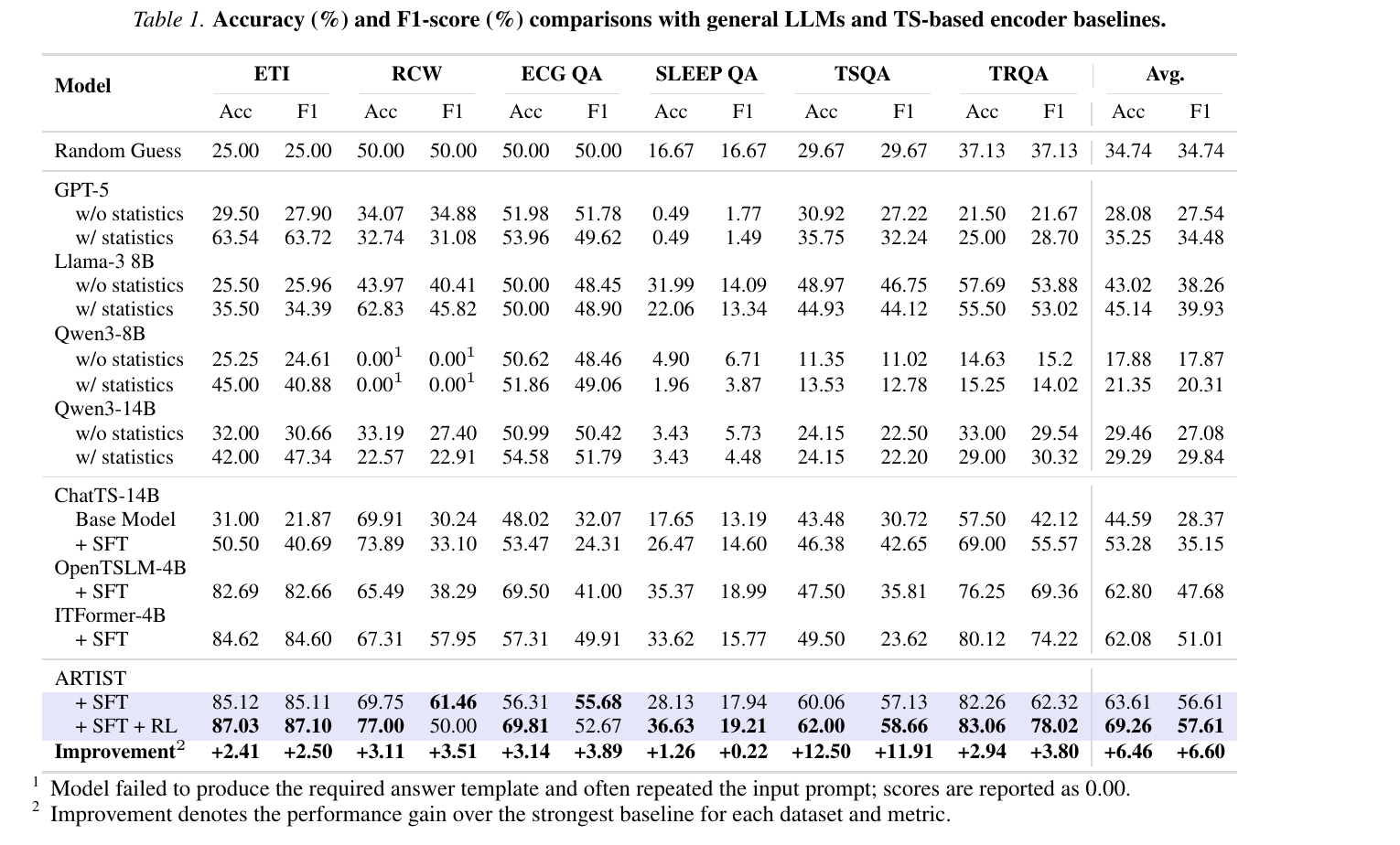
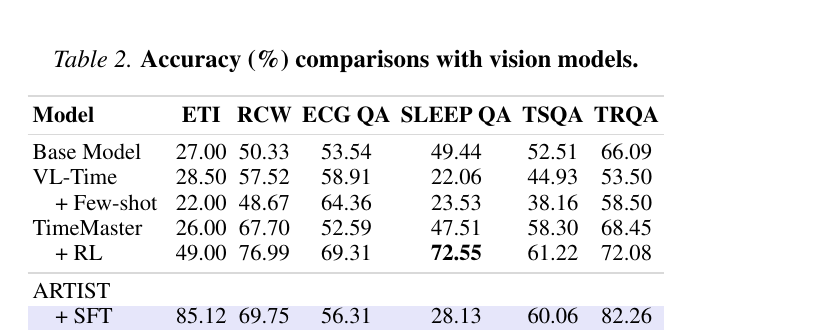
ARTIST beats both LLM only and dedicated time series encoder baselines across all six benchmarks. The largest margin is on the shortest sequence benchmark (TSQA, +12.5 pts), with smaller but still positive margins elsewhere.
Ablations#
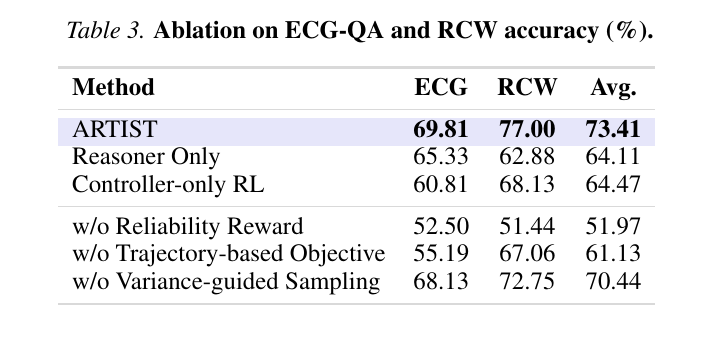
Point drops when each component is removed:
Reasoner only (no controller RL):
Controller only RL (no reasoner RL):
Without Reliability Reward: (largest drop of any ablation)
Without Trajectory based Objective:
Without Variance guided Sampling: (smallest drop)
The Reliability Reward is clearly doing the most work. Removing it costs more than twice what removing either policy's RL training costs individually.
Cost and long sequence behavior#
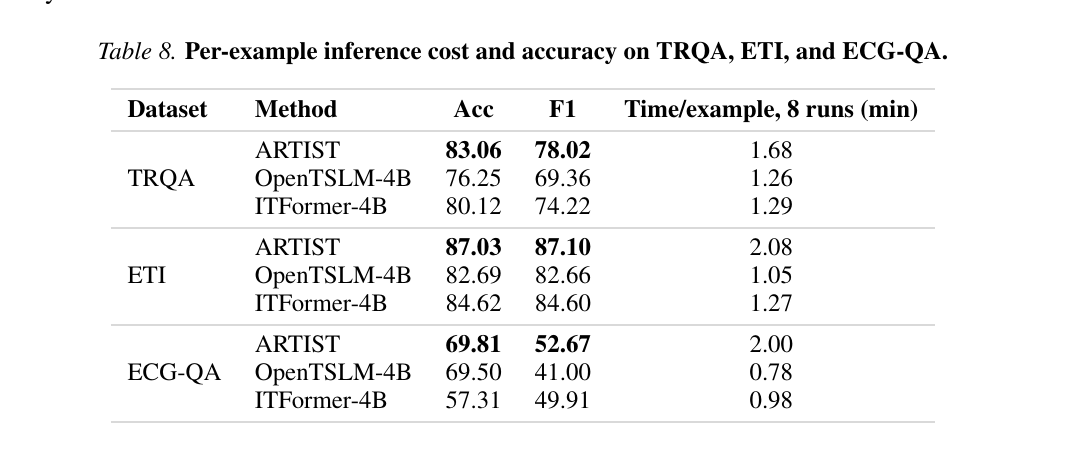
ARTIST is 1.3 to 2.6 times slower per example than the OpenTSLM-4B and ITFormer-4B baselines it beats on accuracy. It is not presented as, and is not, a cheaper system. The accuracy gain is bought with extra inference time compute: multiple controller/reasoner rounds per question, each a full model call.
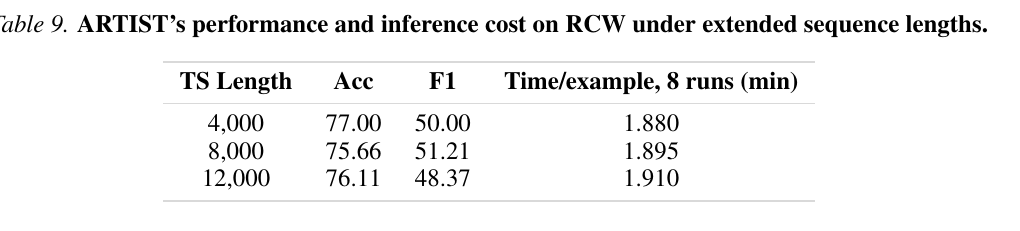
On RCW, ARTIST's own accuracy stays roughly stable from 4K to 12K steps. The paper does not retrain ARTIST at the longer lengths, and it does not re-test the baselines at those lengths either. This table shows ARTIST doesn't visibly degrade as length grows, but it does not establish that its margin over the baselines holds at longer lengths, since the baselines simply aren't measured there.
Limitations#
Reported benchmarks mostly have fixed or narrow sequence length distributions, one length per dataset. Cross length generalization within a single trained model isn't directly tested.
The controller's full sequence access at every round means the benefit of selective reasoning is really about what the reasoner sees, not about avoiding full sequence processing altogether. The full sequence is still read, every round, by the controller.
No ablation isolates "SFT+RL training" from "adaptive segmentation" as competing explanations for the gains.
My Interpretation#
ARTIST solves the problem of asking an NLP system questions about a time series that need actual temporal reasoning, not generic description. Feeding an LLM a full, say 4000 length, whale sound time series makes this hard, and can make relevant local temporal patterns harder to isolate. The controller chooses segments, the reasoner looks at them and produces an intermediate answer and rationale, which then informs the next controller decision, and iterative selection lets the system build toward an answer through genuine iterative reasoning rather than one shot guessing, where a one shot evidence set is fixed before reasoning starts and can't be corrected.
At shorter sequence lengths, the ablations (Table 3) show that RL training on both halves of the system matters a lot, particularly the Reliability Reward, whose removal costs more than double either policy's RL training alone ( vs. / ). No single piece, segmentation choice or RL training alone, explains all of the gain, though the paper does not run a clean SFT+RL-without-segmentation baseline that would isolate the two factors completely.
Whether ARTIST's advantage holds at longer sequence lengths is a genuinely open question. Table 9 shows ARTIST's own accuracy staying roughly flat from 4K to 12K steps on RCW, but the baselines are never re-tested at those lengths, so there is no direct evidence either way about whether its margin over them holds or shrinks.
On cost: ARTIST is 1.3 to 2.6 times slower per example than the baselines it beats (Table 8), not cheaper. It trades extra inference time compute, multiple full model calls per question, for accuracy. That cost is tied to the number of controller/reasoner rounds, since each round involves another model call, which makes inference cost an important practical constraint, especially in settings where repeated model calls are expensive.
Giving a reasoner only the evidence it needs, chosen well, is plausible as a path to more detailed reasoning than a reasoner whose direction is set by a controller's prior decisions. ARTIST's own design already partly tests a version of this (segment selection vs. full sequence reasoning) and wins, but it does not test independent per segment reasoning without a shared, repeatedly updated controller steering every round. That is the specific variant the proposal below is about.
My Proposal: an Evidence Bank with Independent Segment Reasoners#
The idea. Replace the controller's repeated full- access with a one time Evidence Bank of candidate segments, built once per series. A Question Planner decomposes the question into evidence requirements. A Router scores candidate segments against those requirements and selects the top . The router could either perform hard top- selection or retain a relevance weight for each selected segment; I would initially test the simpler top- version and introduce weighting as a later ablation. Instead of one reasoner being redirected round by round by a controller, independent reasoners analyze the selected segments with no shared state between them, and an aggregation mechanism combines their findings into a final answer.
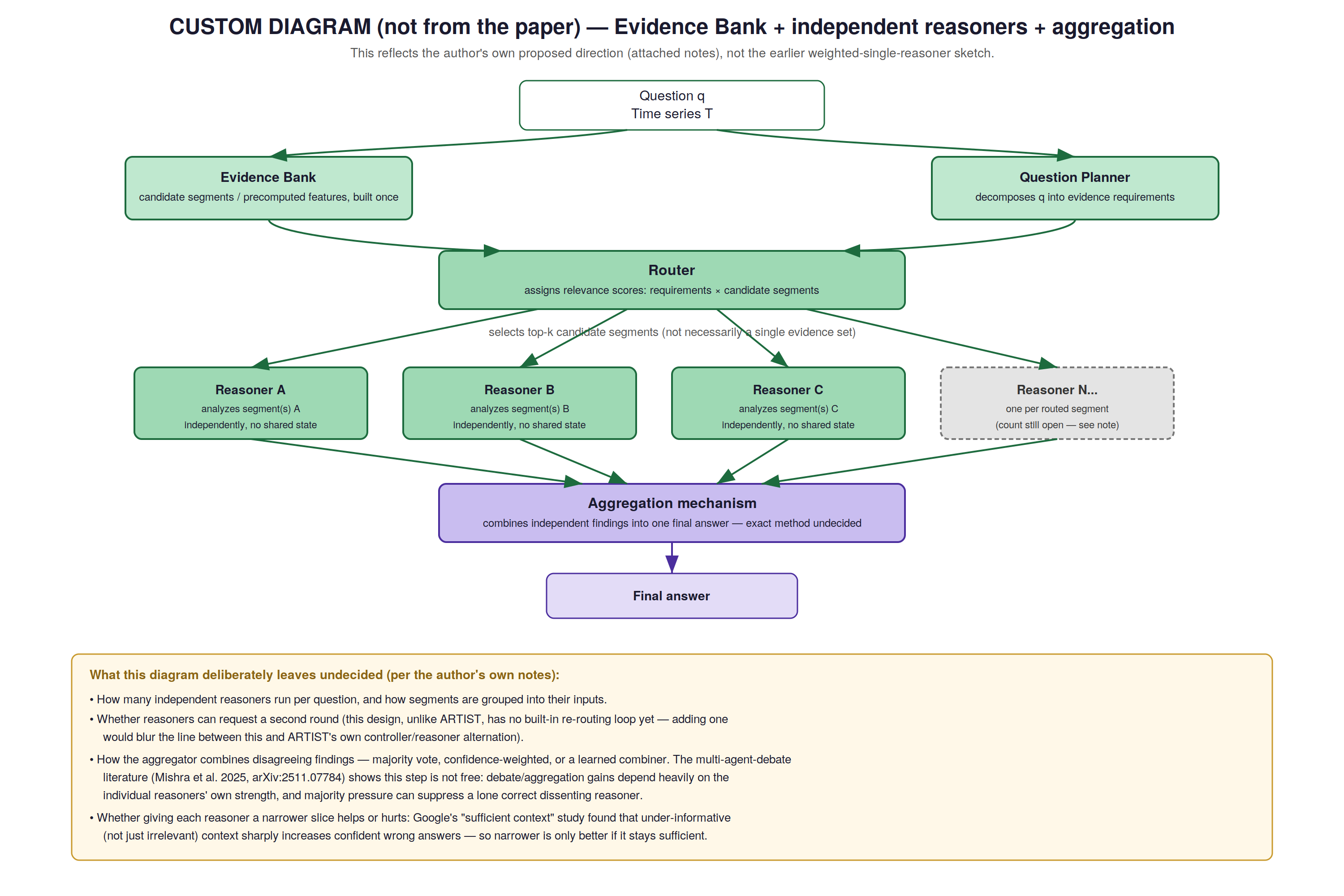
Worked example. Question: "Did the patient's signal recover after the abnormal event?" The Evidence Bank holds candidate segments covering the baseline before the event, the event itself, and the window after it. The Router assigns these three segments the highest relevance scores. Three independent reasoners each analyze one segment, baseline, event, recovery window, without seeing each other's output. The aggregator compares the recovery window reasoner's finding against the baseline reasoner's finding to produce the final yes or no answer with justification.
Why this might help. A reasoner forced to follow a controller's round by round redirection is partly constrained by that controller's earlier choices, while a self contained reasoner given its full segment up front, with no further redirection, can analyze it more thoroughly on its own terms. This is a hypothesis: I have not found a result that directly tests this specific comparison, controller redirected iterative reasoning vs. independent parallel reasoning over pre-selected segments, for time series QA.
What's directly supported, inferred, or still open, component by component:
Component Status Basis
Treating segmentation as a retrieval problem is useful Demonstrated by ARTIST itself ARTIST's whole premise and Table 1 results Pre-computing candidate segments once instead of repeatedly processing the full representation Reasonable inference Table 8 shows ARTIST pays real inference cost for its repeated full sequence controller calls; a one time evidence bank is plausible but untested here Question decomposition plus relevance routing over segments Supported by adjacent literature SEG-MoE (arXiv 2601.21641v1) shows segment-wise routing/MoE improves time series modeling (+12.8% MSE over TimeXer on ETTh1); a different task (forecasting, not QA) but the same routing idea Independent reasoners instead of one controller-directed reasoner Original hypothesis Not directly tested by ARTIST or, as far as I found, by prior work specific to time series Aggregating independent reasoners' outputs is free or reliable Not supported, actively contradicted in general Mishra et al. 2025 (arXiv:2511.07784) on LLM multi-agent debate: aggregation gains depend heavily on individual agent strength; majority pressure can suppress a correct lone dissenter (30--34% success overturning an incorrect majority) Narrower per-reasoner context helps rather than hurts Conditionally supported Google's "sufficient context" study: insufficient context sharply raises confident wrong answers (10.2% to 66.1% incorrect in one model); narrower only helps if each reasoner's slice stays sufficient
What this does not claim. This architecture is not claimed to improve accuracy over ARTIST. No existing study establishes that, and there are no results of my own yet. The claim is narrower: structured evidence retrieval plus independent segment level reasoning plus aggregation might preserve or improve answer quality while reducing how much raw temporal data is repeatedly reprocessed, and that is precisely the experiment that would need to be run.
Falsifiable experimental design.
Baselines: ARTIST as published, a no-selection full-sequence baseline, and a single-reasoner version of this proposal (Router selects evidence, one reasoner sees all of it, isolating whether independence specifically matters).
Ablations: with/without the Question Planner, with/without independent reasoners (single pooled reasoner vs. independent ones), with/without an aggregation confidence step (majority vote vs. confidence weighted).
Metrics: accuracy and F1 on the same six ARTIST benchmarks; evidence localization accuracy; temporal coverage; inference cost (wall clock); number of model calls per question; total context/token usage; latency; and a direct comparison against ARTIST's Reliability Reward ablation (), the single largest lever ARTIST found.
Limitations of the proposal itself. It has no built-in re-routing loop the way ARTIST's controller does; if a reasoner's segment turns out to be insufficient, there is currently no mechanism to request a different one. It also does not yet specify how many reasoners run per question or how the aggregator resolves disagreement, both of which the literature above suggests materially affect outcomes.